
- CAS
- Purity
- 544-63-8
- 99%

Location:Home > Pharmaceutical
|
Chemical Description |
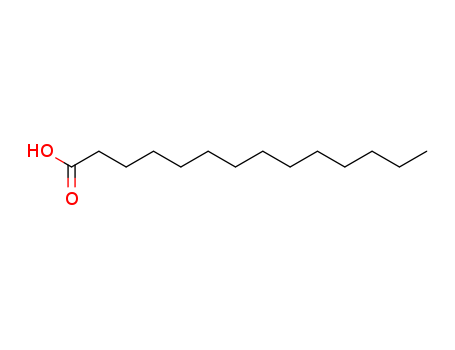
Myristic acid is a fatty acid that is also conjugated with glutamate ester to form myristoylated conjugates. |
|
Preparation |
To prepare the myristic acid, the methyl ester of the mixed fatty acids or mixed fatty acid methyl ester obtained from the coconut oil or palm kernel oil is subject to vacuum fractionation, obtaining myristic acid. For laboratory preparation, glycerol tris (tetradecanoate) is subject to saponification with 10% sodium hydroxide solution, further being acidified with hydrochloric acid to obtain the free myristic acid. It can also be made from tetradecanol. |
|
Toxicity |
Natural fatty acids, non-toxic Can be safely used for food (FDA, § 172.860; 2000). LD50:43 mg/kg (mouse, transdermal). |
|
Use limit |
FEMA (mg/kg): soft drinks 5.3, cold drinks 2.6~10, candy 4.1, baked goods 5.3, pudding class 0.10. |
|
Production Methods |
Myristic acid occurs naturally in nutmeg butter and in most animal and vegetables fats. Synthetically, it may be prepared by electrolysis of methyl hydrogen adipate and decanoic acid or by Maurer oxidation of myristyl alcohol. |
|
Air & Water Reactions |
Insoluble in water. |
|
Reactivity Profile |
Myristic acid is a carboxylic acid. Carboxylic acids donate hydrogen ions if a base is present to accept them. They react in this way with all bases, both organic (for example, the amines) and inorganic. Their reactions with bases, called "neutralizations", are accompanied by the evolution of substantial amounts of heat. Neutralization between an acid and a base produces water plus a salt. Carboxylic acids with six or fewer carbon atoms are freely or moderately soluble in water; those with more than six carbons are slightly soluble in water. Soluble carboxylic acid dissociate to an extent in water to yield hydrogen ions. The pH of solutions of carboxylic acids is therefore less than 7.0. Many insoluble carboxylic acids react rapidly with aqueous solutions containing a chemical base and dissolve as the neutralization generates a soluble salt. Carboxylic acids in aqueous solution and liquid or molten carboxylic acids can react with active metals to form gaseous hydrogen and a metal salt. Such reactions occur in principle for solid carboxylic acids as well, but are slow if the solid acid remains dry. Even "insoluble" carboxylic acids may absorb enough water from the air and dissolve sufficiently in Myristic acid to corrode or dissolve iron, steel, and aluminum parts and containers. Carboxylic acids, like other acids, react with cyanide salts to generate gaseous hydrogen cyanide. The reaction is slower for dry, solid carboxylic acids. Insoluble carboxylic acids react with solutions of cyanides to cause the release of gaseous hydrogen cyanide. Flammable and/or toxic gases and heat are generated by the reaction of carboxylic acids with diazo compounds, dithiocarbamates, isocyanates, mercaptans, nitrides, and sulfides. Carboxylic acids, especially in aqueous solution, also react with sulfites, nitrites, thiosulfates (to give H2S and SO3), dithionites (SO2), to generate flammable and/or toxic gases and heat. Their reaction with carbonates and bicarbonates generates a harmless gas (carbon dioxide) but still heat. Like other organic compounds, carboxylic acids can be oxidized by strong oxidizing agents and reduced by strong reducing agents. These reactions generate heat. A wide variety of products is possible. Like other acids, carboxylic acids may initiate polymerization reactions; like other acids, they often catalyze (increase the rate of) chemical reactions. |
|
Fire Hazard |
Myristic acid is probably combustible. |
|
Pharmaceutical Applications |
Myristic acid is used in oral and topical pharmaceutical formulations. Myristic acid has been evaluated as a penetration enhancer in melatonin transdermal patches in rats and bupropion formulations on human cadaver skin.Further studies have assessed the suitability of myristic acid in oxymorphone formulations and clobetasol 17-propionate topical applications.Furthermore, polyvinyl alcohol substituted with myristic acid (as well as other fatty acids) at different substitution degrees has been used for the preparation of biodegradable microspheres containing progesterone or indomethacin. |
|
Biochem/physiol Actions |
Myristic acid is commonly added via a covalent linkage to the N-terminal glycine of many eukaryotic and viral proteins, a process called myristoylation. Myristoylation enables proteins to bind to cell membranes and facilitates protein-protein interactions. Myristolyation of proteins affect many cellular functions and thus has implications in health and disease . |
|
Safety Profile |
Poison by intravenous route. Mutation data reported. An eye and human skin irritant. When heated to decomposition it emits acrid smoke and irritating fumes. |
|
Safety |
Myristic acid is used in oral and topical pharmaceutical formulations and is generally regarded as nontoxic and nonirritant at the levels employed as an excipient. However, myristic acid is reported to be an eye and skin irritant at high levels and is poisonous by intravenous administration. Mutation data have also been reported. LD50 (mouse, IV): 0.043 g/kg LD50 (rat, oral): >10 g/kg |
|
Purification Methods |
Purify the acid via the methyl ester (b 153-154o/10mm, n25 1.4350), as for capric acid. [Trachtman & Miller J Am Chem Soc 84 4828 1962.] Also purify it by zone melting. It crystallises from pet ether, and is dried in a vacuum desiccator containing shredded wax. [Beilstein 2 IV 1126.] |
|
Incompatibilities |
Myristic acid is incompatible with strong oxidizing agents and bases. |
|
Regulatory Status |
GRAS listed. Included in the FDA Inactive Ingredients Database (oral capsules). Included in nonparenteral medicines licensed in the UK. |
|
General Description |
Myristic acid is a saturated fatty acid (tetradecanoic acid) identified as one of the constituents in the phytochemical analysis of *Horsfieldia iryaghedhi* seeds, alongside lignans and other compounds. It is also utilized in the synthesis of structurally defined triglyceryl fatty acid esters, serving as a key component in the development of oil gelators due to its alkyl chain properties, which influence gelation efficiency in various oils. |
|
Chemical properties |
Myristic acid appears as white to yellowish white solid, sometimes appearing as shiny crystalline solid, or white to yellowish white powder. It has a relative density of 0.8739 (80 ℃), melting point of 54.5 ℃ and the boiling point of 326.2 ℃. Its refractive index (nD60) is 1.4310. It is not soluble in water but soluble in ethanol, ether and chloroform. Myristin contains about 70% to 80% while other kinds of coconut oil, palm kernel oil also contain it. |
|
Application |
It can be used as a chemical agent, also for the synthesis of spices and organic matter It can be used in the manufacture of emulsifiers, waterproofing agents, curing agents, PVC heat stabilizers and plasticizers, and also used as the raw materials of spices and pharmaceutical. It is mainly used as raw materials for the production of surfactants for the production of sorbitan fatty acid esters, glycerol fatty acid esters, ethylene glycol or propylene glycol fatty acid esters. It can also be used for the production of isopropyl myristate and so on. It can also be used for defoamers and flavoring agent. According to the provision of China GB2760-89, it can be used to prepare a variety of food spices. |
|
Definition |
ChEBI: A straight-chain, fourteen-carbon, long-chain saturated fatty acid mostly found in milk fat. |
InChI:InChI=1/C14H28O2/c1-2-3-4-5-6-7-8-9-10-11-12-13-14(15)16/h2-13H2,1H3,(H,15,16)
-
A mild method for the oxidation of acety...
Six undescribed long-chain fatty acid es...
Hydrolysis of amides to carboxylic acids...
Hybrid co-assembly of polyoxometalates (...
Biotechnological strategies using renewa...

p-nitrophenyl myristate

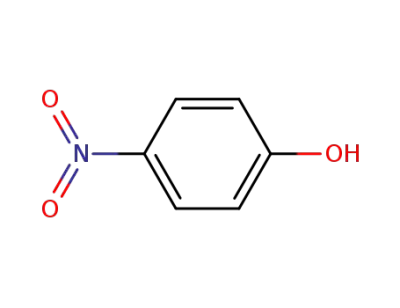
4-nitro-phenol

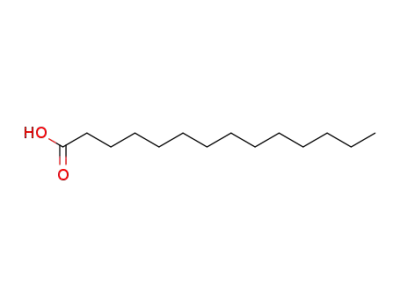
n-tetradecanoic acid
| Conditions | Yield |
|---|---|
|
With
4-(dialkylamino)pyridine linear oligomer (4) (n ca. 10); phosphate buffer pH 8.0;
In
methanol;
at 30 ℃;
Rate constant;
other p-nitrophenyl alkanoates and 4-(dialkylamino)pyridines; dependence of reaction velocity on alkanoate chain length;
|
|
|
With
N,N',N'',N'''-tetrakis-<10-
|
|
|
With
sodium phosphate buffer; Klebsiella sp. ZD112 pyrethroid-hydrolyzing esterase;
In
acetonitrile;
at 30 ℃;
pH=7.0;
Enzyme kinetics;
|
|
|
With
bovine submaxillary mucin type I; water;
at 37 ℃;
pH=7.2;
Reagent/catalyst;
Kinetics;
sodium phosphate buffer;
|
|
|
With
Bacillus subtilis recombinant spore coat lipase C; water;
In
acetonitrile;
at 20 ℃;
pH=8.5;
Temperature;
pH-value;
Kinetics;
aq. buffer;
Enzymatic reaction;
|
|
|
With
carboxylesterase EstSt7 from Sulfolobus tokodaii strain 7; water;
In
ethanol;
at 80 ℃;
pH=9;
Kinetics;
Enzymatic reaction;
|
|
|
With
recombinant esterase from Rhizomucor miehei;
In
isopropyl alcohol;
at 50 ℃;
for 0.166667h;
pH=7.5;
Catalytic behavior;
Enzymatic reaction;
|
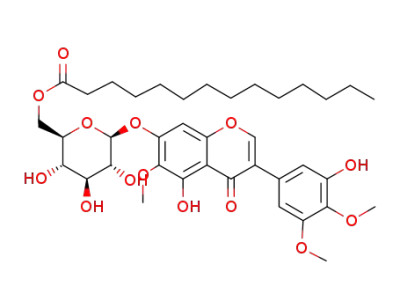
belamcandnoate B
n-tetradecanoic acid
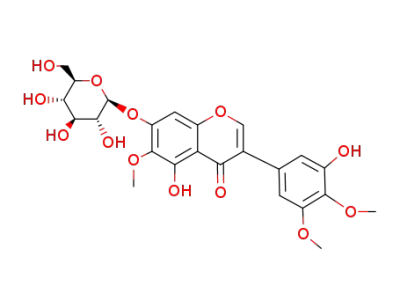
5,3′-dihydroxy-6,4′,5′-trimethoxyisoflavone-7-O-β-glucoside
| Conditions | Yield |
|---|---|
|
With
water; sodium hydroxide;
In
methanol;
at 20 ℃;
for 24h;
|

octadec-4-enoic acid

(2S,3R,4E)-2-amino-4-octadecene-1,3-diol

1-decanoic acid
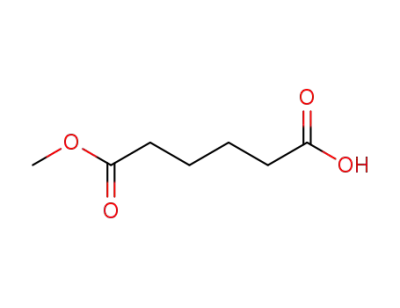
adipic acid monomethyl ester

myristic acid-(3-tetrahydro[2]furyl-propyl ester)

myristic acid-(1-methyl-3-tetrahydro[2]furyl-propyl ester)

myristic anhydride
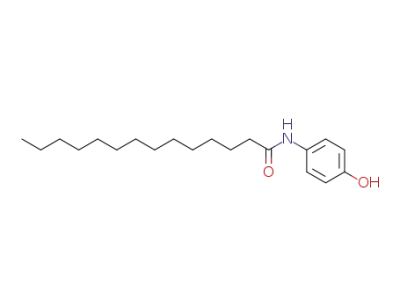
N-(4-hydroxyphenyl)tetradecanamide